
Why do point sources matter in pheromone mating disruption?
Not all pheromone products deliver the same results. The type of dispenser, how the pheromone is deployed, makes all the difference in effectiveness. There are three main categories of pheromone formulations on the market today, and understanding how they differ is the first step to making the right choice for your operation.
Three formulation types
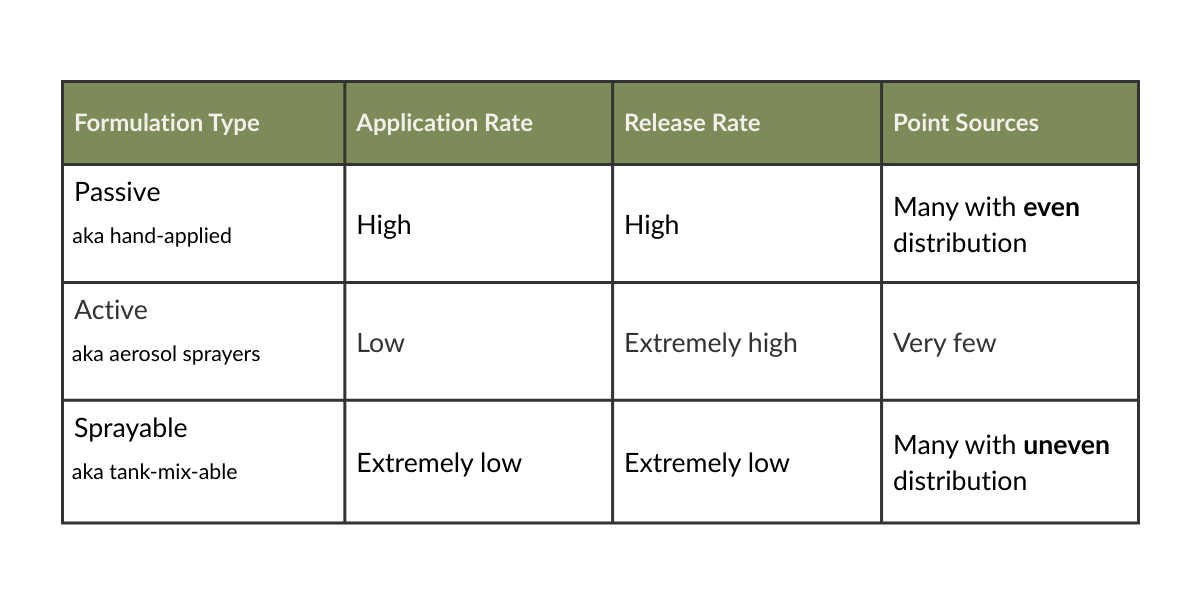
Each of these approaches has a fundamentally different relationship between how much product you use, how consistently it releases pheromone into the environment, and how many individual point sources it creates. That last column, point sources, turns out to be the most critical factor.
The key advantage: Even distribution through point sources
Here's what makes passive dispensers superior: concentrated pheromone hotspots perfectly mimic natural female moth plumes, confusing male moths so they can't locate real mates. Hand-applied dispensers excel at this because they let you strategically place each point source exactly where it's needed—creating optimal density throughout your treatment area without coverage gaps. With 200 dispensers strategically placed per acre, you establish hundreds of point sources that continuously release pheromone, saturating the environment regardless of scattered pest populations, wind, uneven topography, or canopy density. This blanket of pheromone makes it nearly impossible for males to locate females, no matter where pests are in your block.

Sprayable pheromone formulations, by contrast, face the same limitations as traditional pesticides. They result in uneven coverage, hot spots, and gaps—especially in dense canopies or on windy days. The pheromone is only present where spray droplets land, and it degrades within days or weeks, requiring repeated applications throughout the season. Passive dispensers? One application at the beginning of the season works through harvest.
When active emitters are the right tool
Passive dispensers aren't always the only answer. For some growers, active emitters like Isomate Mist (aerosols) are genuinely the better fit. Precision aerosol formulations give reliable and consistent pest control without the time and crew requirements of individual dispenser placement. If labor is a limiting factor, the low use rate of active units is a significant advantage—rather than walking every row to hand-apply hundreds of dispensers, a grower can cover an entire block with just a handful of devices. For large commercial operations where rapid deployment is a priority, efficiency can outweigh other considerations.
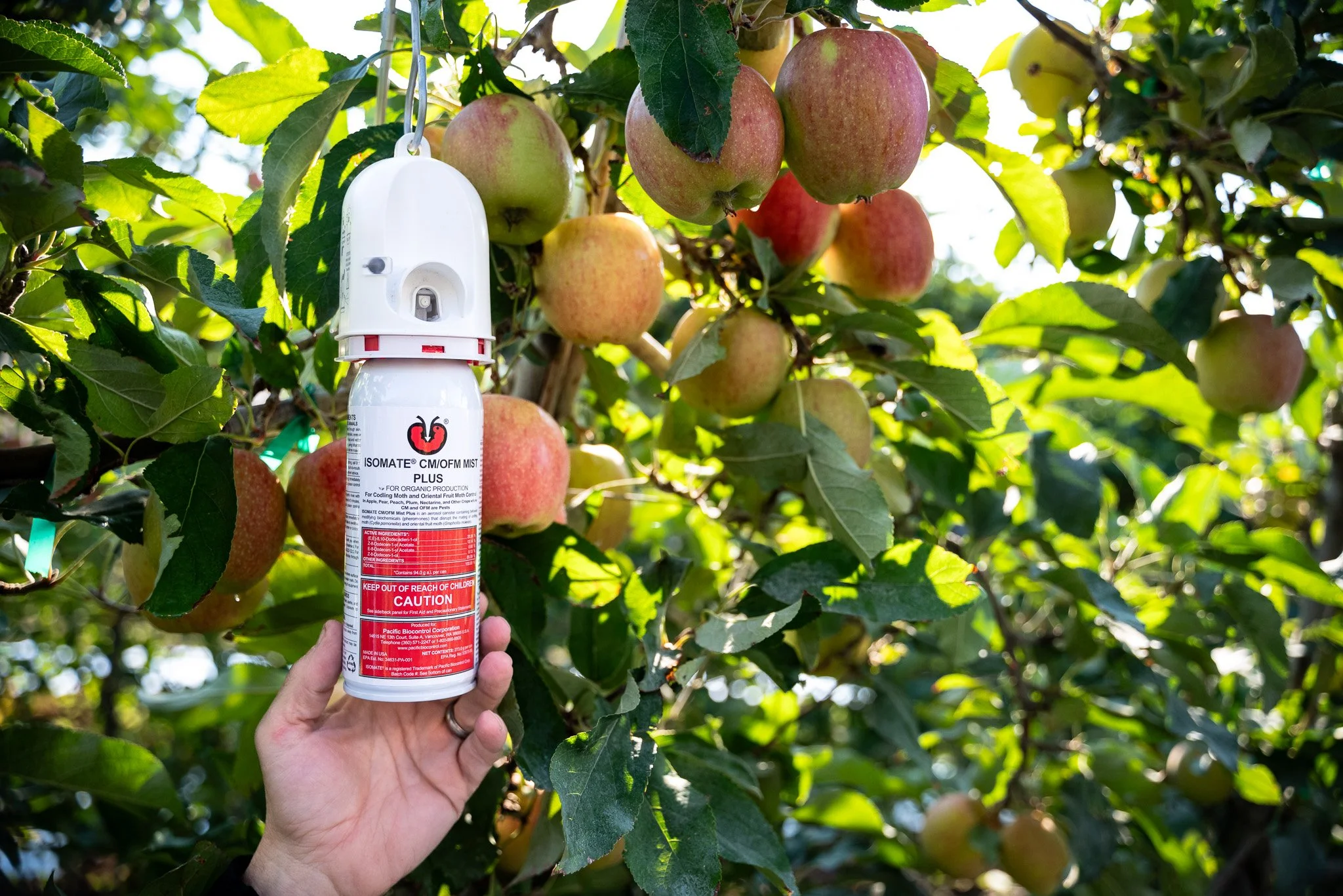
Active emitters also shine in low pest pressure situations. When populations are minimal, aerosols like Isomate Mist can flood a block with pheromone even from very few point sources successfully while save deployment labor. The goal is always preventative management (disruption). The extremely high release rate of active emitters under low pressure ensures the coverage gaps that would be problematic under high pressure become far less consequential—there simply aren't enough males navigating the block for uneven distribution to matter much.
The tradeoff to keep in mind is that active units introduce mechanical and logistical dependencies: batteries, moving parts, potential gaps if a single point of failure occurs vs hundreds of passive dispensers. For blocks with complex topography, dense canopies, or historically high pest pressure, those limitations become more significant. But for the right situation—low populations, labor constraints, and large blocks—Isomate Mist is a proven and practical choice.
The Bottom Line
When you're choosing a mating disruption program, don't just compare active ingredients—compare delivery systems. A high use rate of many evenly distributed point sources isn't a drawback; it's matching the threat (pest density) to the dispenser technology that drives success. Passive dispensers leverage both of those qualities to deliver season-long, consistent protection that active and sprayable alternatives simply can't match. Precision targeting makes high-density point sources one of the most effective pest control methods available—and passive dispensers put that precision entirely in your hands.